MCP Client and Server Architecture
What is the Model Context Protocol?
The Model Context Protocol (MCP) enables AI applications to access external tools, data sources, and prompts. It serves as a bridge between AI models and the outside world, allowing language models to interact with application-specific resources and functionality.
MCP provides several core capabilities:
- Tools: Functions that can be invoked by LLM applications
- Resources: Data that can be accessed by LLM applications
- Prompts: Templates for LLM interactions
- Notifications: Event-based communication between server and client
In short, MCP gives LLM applications a standardized way to interact with external resources and tools.
Architecture
The AJ MCP SDK is structured around several core components that work together to implement the MCP specification:
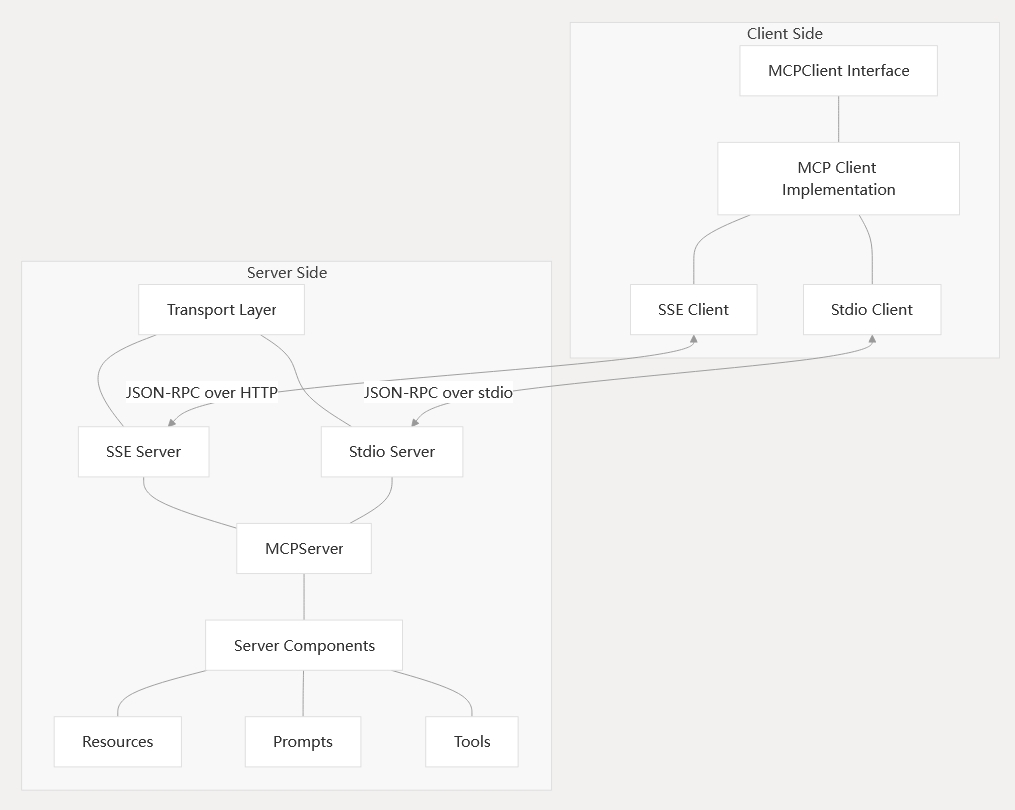
The architecture follows a client-server model with three transports: standard I/O pipes, the legacy two-endpoint
HTTP/SSE transport, and Streamable HTTP. All transports exchange JSON-RPC messages; Streamable HTTP is available for MCP
2025-03-26 and 2025-06-18.
Stdio Mode vs SSE Mode Comparison
| Feature | STDIO | Legacy HTTP/SSE | Streamable HTTP |
|---|---|---|---|
| Deployment | Local subprocess | Independent server | Independent server |
| Configuration | Subprocess command | Separate SSE and POST endpoints | One MCP endpoint; optional GET event stream |
| Multi-client support | One process connection | Supported | Supported by session ID |
| Network requirement | None | Required | Required |
| Protocol revisions | All implemented revisions | Legacy-compatible transport | 2025-03-26 / 2025-06-18 |